Boston Asian American Film and Video Festival Program (2001–2002)
-
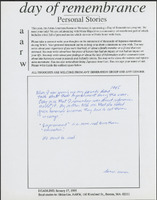 Asian American Resource Workshop Day of Remembrance 1995 Personal Stories The AARW Day of Remembrance statements from January 1995 reveal how the trauma of Japanese American incarceration continued to shape Asian American identity, political consciousness, and community memory decades after World War II. These sources show that Executive Order 9066 was not only a historical injustice that uprooted more than 120,000 people of Japanese ancestry, but also a long-term wound that affected families across generations. One writer, C. Okamoto, describes constitutional rights being suspended, entire communities being displaced, and the lasting psychological impact on those who experienced or inherited the memory of camp life. While one author emphasizes vigilance and democratic responsibility, warning that ordinary citizens and political leaders enabled the camps, others express pain, silence, and intergenerational confusion as families struggle to talk about their experiences. One Sansei author mentions that her mother struggles to discuss her experiences, and how she struggled to understand how the “evacuation” (or, as the daughter describes it, imprisonment) happened. She goes on to explain how her mother had only referenced this period of time once - when she explained to the daughter that she “hated green bananas because they had to eat them ‘in camp’”. Statements about generational silence and lack of information point to the ways families in immigrant neighborhoods prioritized rebuilding their lives, often without public recognition of their struggles or contributions. The statements also reflect how Asian American history was erased from mainstream education and public conversation, making it even more difficult for families to relay these experiences. The writers also repeatedly confront the paradox of being both highly visible (as targets of suspicion) and invisible (ignored in public memory and school curricula). Henry Yoshimura comments on this, illustrating a larger pattern for Asian Americans in the U.S.: During WWII, Japanese Americans were singled out as a threat, but by the 1990s Asian communities in places like Chinatown were often stereotyped as silent, apolitical, and “model minority” residents whose history did not matter. This is also reflected in much of the media, where Asian Americans are often relegated to side characters or those only present to support and amplify other’s voices, clearly describing the link to Asian American Cinema and the need for representation. The sources challenge the silent narrative by insisting that internment was a constitutional crisis enabled by fear, racial profiling, and government power, all conditions that still affect Asian Americans today. Statements about shame, generational silence, and a lack of historical knowledge point to how families in Asian American neighborhoods often avoided talking about trauma to focus on rebuilding economic stability. This mindset is reflective of immigrant culture, where survival and community support are priorities. At the same time, these voices testify to resilience: one author, Kiyo Morimoto, highlights his military service immediately following Pearl Harbor as a claim to belonging, and many insist on pride in family survival, showing how Third and Fourth generation Japanese Americans linked their history to contemporary Asian American political organizing. Taken together, these primary sources show how remembering internment became a form of activism for Asian Americans, connecting past injustices to contemporary struggles against scapegoating, xenophobia, and the “perpetual foreigner” stereotype. They demonstrate that Day of Remembrance events were not only memorials, but also tools to build solidarity, challenge historical amnesia, and assert that Asian Americans are part of the ongoing fight to protect civil rights for all communities, both then and now. Today, these sources still resonate: the fear described when seeing Pearl Harbor slogans is echoed in recent anti-Asian violence during the COVID-19 pandemic, and the ignorance about internment mirrors the continued lack of Asian American history in U.S. education. Ultimately, these primary sources reveal that remembering internment is not just about Japanese American history - it is about claiming voice and belonging for Asian Americans in cities like Boston, and reasserting that Asian communities have long confronted racism, resisted erasure, and helped shape American democracy both then and now. - Bhavya Kilambi
 -
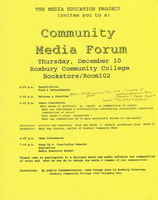 Community Media Forum Yellow flyer for a “Community Media Forum” organized by the Media Education Project at Roxbury Community College. The event is held on Thursday, December 10 in the college bookstore (Room 102). The program includes 4:30 p.m. registration with food and refreshments; 5:00 p.m. welcome and overview; 5:15 p.m. panel discussion with editors and reporters from the Globe and Herald and producers from WCVB TV, moderated by Mary Ann Crayton, editor of Roxbury Community News; 6:45 p.m. open discussion; and 7:30 p.m. wrap-up, evaluation, and distribution of a media resource packet. The panel addresses how news media represents communities of color, what makes reporting on these communities difficult, what makes a story newsworthy, and how communities can gain better access to the media. Directions at the bottom explain how to reach Roxbury Community College at 1234 Columbus Avenue by Orange Line to Roxbury Crossing.
 -
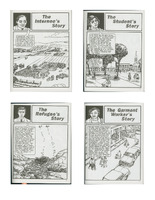 Four Images from the Asian American Comic Book This is taken from the Asian American Comic Book that has four of the pages put together on one page for timeline viewing. This is altered from the original source because it displays four pages on one.
 -
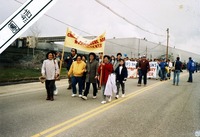 [Untitled]
 -
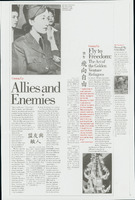 Bu Gao Ban, Winter 1996 (Page 5) A selected page from the Winter 1996 edition of the Bu Gao Ban. The first article featured on the page, "Allies and Enemies," aims to inform readers of a new project to begin the dialogue centering around Asian American experiences during World War II. The second article, "Fly to Freedom: The Art of the Golden Venture Refugees," highlights a new installation at the museum that displays the art created by 50 incarcerated Chinese immigrants. The column, "Did You Know?," discusses the portrayal of minorities in movies during the war.
 -
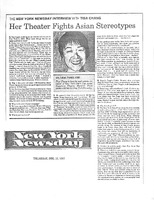 Her Theater Fights Asian Stereotypes A newspaper interview published in New York Newsday on December 17, 1987, in which journalist Randall Short speaks with director Tisa Chang about the founding and mission of the Pan Asian Repertory Theatre, challenges faced by Asian American performers, and the political and cultural impact of the company’s work.
 -
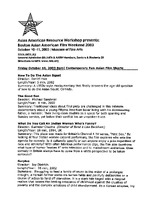 Boston Asian American Film Weekend 2003 Program (Page 1) This program guide documents the 2003 Boston Asian American Film Weekend, organized by the Asian American Resource Workshop (AARW) at the Museum of Fine Arts, Boston. It features a selection of films, a list of directors, screening schedules, and participating community organizations.
 -
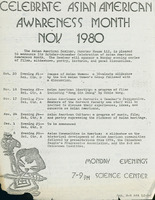 Celebrate Asian American Awareness Month Program Materials for Hito Hata Screening This set of materials documents a November 1980 Asian American Awareness Month event at Harvard University featuring a screening of Hito Hata. The collection includes a printed flyer announcing the Asian American Seminar’s Monday evening series on Asian American films, culture, and community issues, as well as handwritten program notes outlining the schedule, speakers, and affiliated organizations. These notes reference introductions by members of Visual Communications, remarks dedicated to the experiences of Issei, and contributions from groups such as the Asian American Resource Workshop, the Japanese American Citizens League, and the East Coast Asian Students Union. Together, these documents illustrate community organizing efforts, Asian American media advocacy, and student activism during this period.
 -
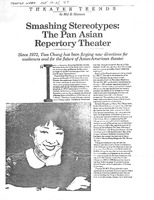 1987 Pan-Asian Repertory Theatre Article Article profiling Tisa Chang and the Pan Asian Repertory Theater, discussing its mission, productions, and role in Asian American theater from the 1970s through the 1980s.
 -
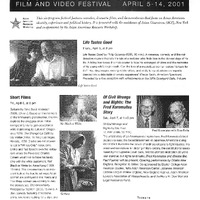
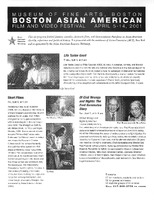 Boston Asian American Film and Video Festival Program Booklet (2001–2002) This ten-page program booklet documents the Boston Asian American Film and Video Festival held at the Museum of Fine Arts, Boston, co-sponsored by the Asian American Resource Workshop. It features detailed schedules, synopses, and descriptions of narrative films, documentaries, and short films created by Asian American filmmakers. The booklet highlights themes of identity, diaspora, immigration, memory, family conflict, gender, interracial dynamics, media stereotypes, and the historical trauma of Japanese American incarceration. It also reflects AARW’s role in promoting Asian American media visibility and fostering community engagement through public film programming.
 -
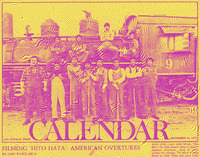 Calendar Filming 'Hito Hata': American Overtures
 -
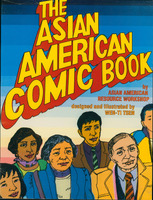 Asian American Comic Book A comic book produced by the Asian American Resource Workshop that tells the story of 4 different Asians living in Boston, MA. The first story is told in the perspective of a man who experienced the Japanese internment camps. The second story is in the perspective of an Indian student studying in college. The third story is from the perspective of a Cambodian refugee and the last story is told from the perspective of a Chinese woman who worked at a garment factory.
Introduction
This page presents the Boston Asian American Film and Video Festival Program Booklet (2001–2002), an archival document preserved in the Asian American Resource Workshop Collection at Northeastern University. The booklet was produced in collaboration with the Museum of Fine Arts, Boston, and features films that explore themes of Asian American identity, diaspora, cultural memory, and political activism. This visualization highlights the historical significance of Asian American film programming in Boston and its contribution to community-based media activism.
- Title
- Boston Asian American Film and Video Festival Program Booklet (2001–2002)
- Creator
- Museum of Fine Arts, Boston (Film Department); Asian American Resource Workshop (AARW)
- Publisher
- Museum of Fine Arts, Boston
- Date Created
- 2001
- Type
- PDF, multi-page printed program (10 pages), scanned document
- Description
- This ten-page program booklet documents the Boston Asian American Film and Video Festival held at the Museum of Fine Arts, Boston, co-sponsored by the Asian American Resource Workshop. It features detailed schedules, synopses, and descriptions of narrative films, documentaries, and short films created by Asian American filmmakers. The booklet highlights themes of identity, diaspora, immigration, memory, family conflict, gender, interracial dynamics, media stereotypes, and the historical trauma of Japanese American incarceration. It also reflects AARW’s role in promoting Asian American media visibility and fostering community engagement through public film programming.
- Language
- English
- Subject
-
Asian American film
Asian American media activism
Film festival programming
Diaspora and identity
Asian American women filmmakers
Community-based media - Place
- Boston
- Temporal Coverage
- 1998-2001
- Identifier
-
M210_B021_F015_BAAFF_CC_001
AARW Collection, Box 021, Folder 015 - Rights
- Courtesy of Northeastern University Archives and Special Collections. Provided for educational and research use only. Copyright status of the original materials may be held by the creators or producers of the films and programs.
- Rights Holder
- Northeastern University Archives and Special Collections
Historical Context
The Boston Asian American Film and Video Festival emerged during a pivotal period in Asian American media history. Throughout the late 1990s and early 2000s, independent filmmaking became a critical space for Asian Americans to resist stereotypes, reclaim narrative agency, and articulate diasporic experiences. Community organizations such as the Asian American Resource Workshop (AARW), Asian CineVision (ACV), and NAATA collaborated with museums and arts institutions to bring Asian American stories to mainstream audiences.
The presence of films addressing Japanese American incarceration (Rabbit in the Moon, The Fred Korematsu Story), Asian American women’s voices, immigration, mixed-race identity, and diaspora reflects a broader cultural movement committed to both artistic expression and political memory work.
What is this source?
This document is the official program booklet for the Boston Asian American Film and Video Festival (2001–2002), a cultural event co-organized by the Museum of Fine Arts Boston and the Asian American Resource Workshop (AARW). It includes film descriptions, screening dates, and information about directors and community partners.
Audience & purpose
The intended audience includes Asian American community members, film enthusiasts, activists, educators, and the general public. The purpose is both promotional and educational: to increase visibility for Asian American filmmakers and to introduce broader audiences to the complexity of Asian American experiences.
Key themes in the source
Across its pages, the program foregrounds themes such as:
-
Immigration and diaspora (e.g., My America—Or Honk If You Love Buddha)
-
Japanese American incarceration and civil rights activism (e.g., Of Civil Wrongs and Rights: The Fred Korematsu Story; Rabbit in the Moon)
-
Asian American women’s voices and feminist perspectives (e.g., Between the Lines: Asian American Women’s Poetry)
-
Media stereotypes and representation politics (e.g., Slaying the Dragon)
-
Intergenerational tensions and identity conflict (e.g., Yellow, Strawberry Fields)
The films collectively depict Asian Americans as complex, multidimensional subjects rather than as the passive or stereotypes figures seen in mainstream media.
Historical context
During the 1990s and early 2000s, Asian American independent film gained national momentum, supported by organizations such as Asian CineVision (ACV), NAATA, and community groups like AARW. This festival occurred during a period when Asian American filmmakers were challenging dominant narratives and asserting cultural citizenship through alternative media spaces.
The focus on Japanese American incarceration films reflects renewed activism around redress and memory work in the post-civil rights era. Likewise, films on gender, sexuality, and interracial dynamics align with the rise of intersectional Asian American feminist media.
Why this source matters for Asian American media activism
This program booklet is not merely an event schedule—it is evidence of:
-
Community-driven media production
-
Institution-community collaboration (MFA × AARW)
-
Public cultural activism through film
-
The construction of Asian American identity through art
By curating films about trauma, resilience, and political struggle, the festival acted as a platform for Asian American communities to rewrite their own narratives and challenge mainstream cultural erasure.
What is not shown
The booklet does not reveal attendance demographics, community reactions, or behind-the-scenes organizing labor. It also does not include filmmaker commentary explaining the challenges of independent production—an important aspect of Asian American media activism.
How it connects to course readings
The themes align with scholarship on:
-
Representation and stereotype critique (e.g., Ono & Pham, Marchetti)
-
Cultural citizenship and community self-representation
-
Media as a tool for political memory and coalition-building
-
Grassroots Asian American arts activism
This source supports arguments that alternative media spaces are crucial for Asian Americans to reclaim narrative agency and preserve community memory.
Why This Source Matters for Asian American Media Activism
This booklet illustrates how Asian American community organizations used film programming as a form of cultural activism. By collaborating with the Museum of Fine Arts and national Asian American media groups, AARW created an important platform for Asian American filmmakers whose perspectives were often erased from mainstream cinema. The festival enabled public engagement, community-building, and political education, positioning film as a vital tool for resisting racial stereotypes and constructing Asian American cultural citizenship.