-
Title
-
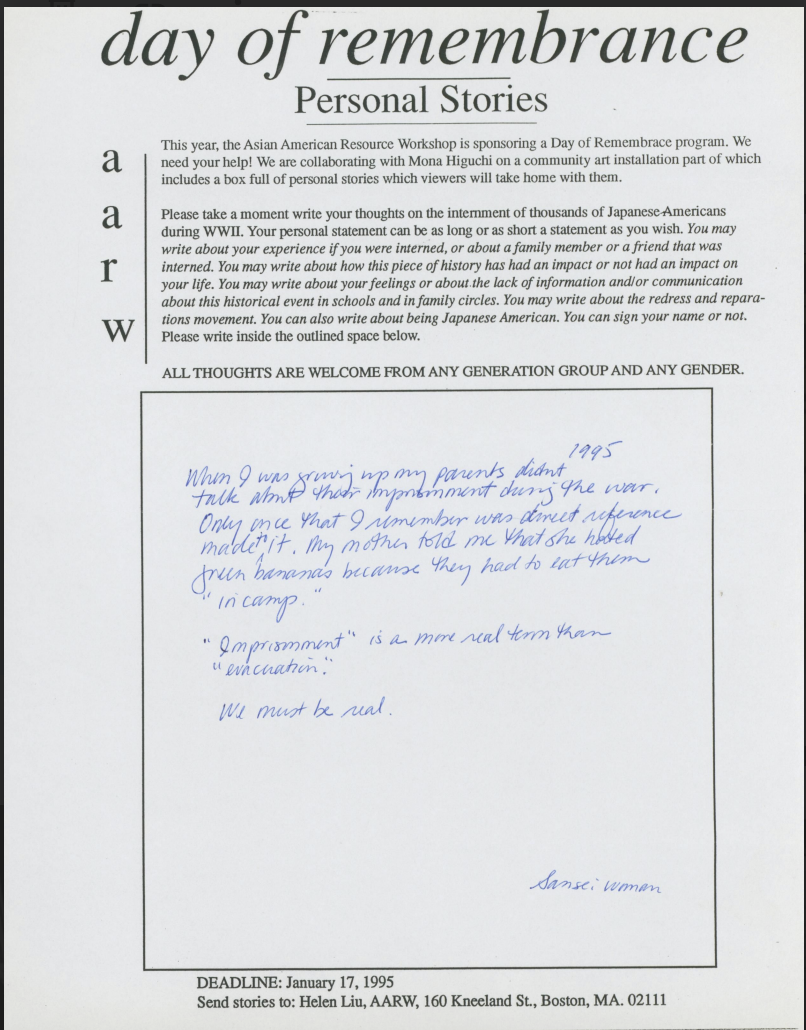
Asian American Resource Workshop Day of Remembrance 1995 Personal Stories
-
Creator
-
Asian American Resource Workshop
-
Contributor
-
C. Okamoto, Sansei woman, Kiyo Morimoto, Henry Yoshimura
-
Publisher
-
Asian American Resource Workshop
-
Date Created
-
January 17, 1995
-
Description
-
The AARW Day of Remembrance statements from January 1995 reveal how the trauma of Japanese American incarceration continued to shape Asian American identity, political consciousness, and community memory decades after World War II. These sources show that Executive Order 9066 was not only a historical injustice that uprooted more than 120,000 people of Japanese ancestry, but also a long-term wound that affected families across generations. One writer, C. Okamoto, describes constitutional rights being suspended, entire communities being displaced, and the lasting psychological impact on those who experienced or inherited the memory of camp life. While one author emphasizes vigilance and democratic responsibility, warning that ordinary citizens and political leaders enabled the camps, others express pain, silence, and intergenerational confusion as families struggle to talk about their experiences. One Sansei author mentions that her mother struggles to discuss her experiences, and how she struggled to understand how the “evacuation” (or, as the daughter describes it, imprisonment) happened. She goes on to explain how her mother had only referenced this period of time once - when she explained to the daughter that she “hated green bananas because they had to eat them ‘in camp’”. Statements about generational silence and lack of information point to the ways families in immigrant neighborhoods prioritized rebuilding their lives, often without public recognition of their struggles or contributions. The statements also reflect how Asian American history was erased from mainstream education and public conversation, making it even more difficult for families to relay these experiences. The writers also repeatedly confront the paradox of being both highly visible (as targets of suspicion) and invisible (ignored in public memory and school curricula). Henry Yoshimura comments on this, illustrating a larger pattern for Asian Americans in the U.S.: During WWII, Japanese Americans were singled out as a threat, but by the 1990s Asian communities in places like Chinatown were often stereotyped as silent, apolitical, and “model minority” residents whose history did not matter. This is also reflected in much of the media, where Asian Americans are often relegated to side characters or those only present to support and amplify other’s voices, clearly describing the link to Asian American Cinema and the need for representation. The sources challenge the silent narrative by insisting that internment was a constitutional crisis enabled by fear, racial profiling, and government power, all conditions that still affect Asian Americans today. Statements about shame, generational silence, and a lack of historical knowledge point to how families in Asian American neighborhoods often avoided talking about trauma to focus on rebuilding economic stability. This mindset is reflective of immigrant culture, where survival and community support are priorities. At the same time, these voices testify to resilience: one author, Kiyo Morimoto, highlights his military service immediately following Pearl Harbor as a claim to belonging, and many insist on pride in family survival, showing how Third and Fourth generation Japanese Americans linked their history to contemporary Asian American political organizing. Taken together, these primary sources show how remembering internment became a form of activism for Asian Americans, connecting past injustices to contemporary struggles against scapegoating, xenophobia, and the “perpetual foreigner” stereotype. They demonstrate that Day of Remembrance events were not only memorials, but also tools to build solidarity, challenge historical amnesia, and assert that Asian Americans are part of the ongoing fight to protect civil rights for all communities, both then and now. Today, these sources still resonate: the fear described when seeing Pearl Harbor slogans is echoed in recent anti-Asian violence during the COVID-19 pandemic, and the ignorance about internment mirrors the continued lack of Asian American history in U.S. education. Ultimately, these primary sources reveal that remembering internment is not just about Japanese American history - it is about claiming voice and belonging for Asian Americans in cities like Boston, and reasserting that Asian communities have long confronted racism, resisted erasure, and helped shape American democracy both then and now. - Bhavya Kilambi
-
Place
-
Boston, MA
-
Rights Holder
-
Asian American Resource Workshop